In the world of professional drones, the choice of on-board sensor is crucial. Applications, costs and results vary considerably between photogrammetry and LIDAR. Yet these two technologies are often perceived as competing with each other, whereas in fact they are complementary. Wingtra, a major player in vertical take-off and landing (VTOL) UAVs, offers an innovative LIDAR solution that is a game-changer for professionals in the civil engineering, land-use planning, forestry and energy sectors.
In this article, we’ll explore the features of Wingtra LIDAR, its technical advantages, key areas of application, and the essential differences between LIDAR and photogrammetry to help you make an informed choice.
Understanding LIDAR technology

LIDAR (Light Detection and Ranging) is an active remote sensing technology that works by sending laser pulses to the ground and measuring the time they take to return. This data is used to generate highly accurate 3D models of the earth’s surface, regardless of lighting conditions or vegetation cover.
Unlike photogrammetry, which relies on geo-referenced photographs, LIDAR provides information-rich point clouds that can penetrate layers of vegetation to model bare ground, with vertical accuracy down to 3 cm.
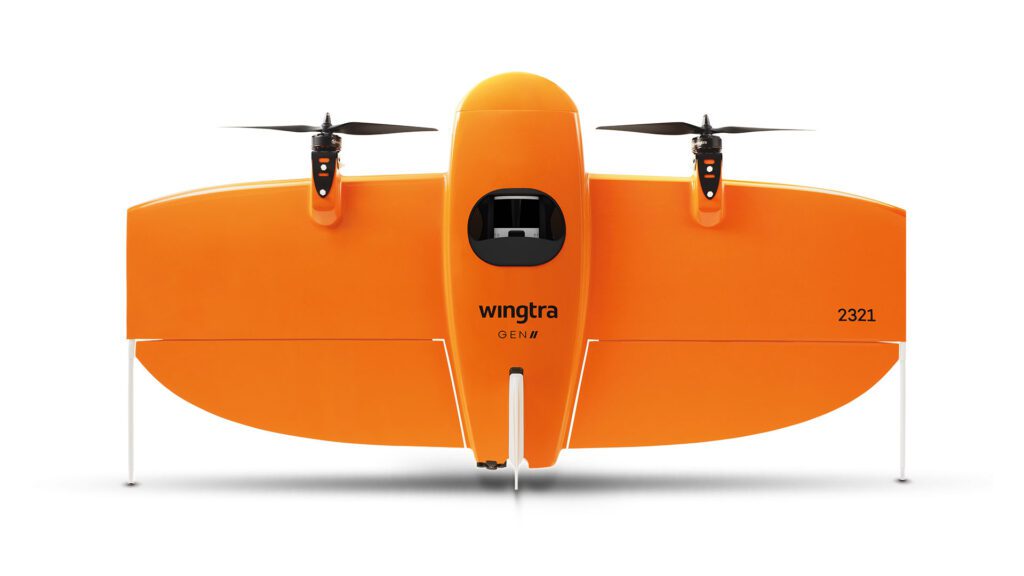
LIDAR onboard the WingtraOne GEN II UAV

The WingtraOne GEN II is a VTOL drone that combines the advantages of an airplane (autonomy and coverage) and a multirotor (vertical takeoff/landing), making it ideal for missions in a variety of environments, including forests and mountains.
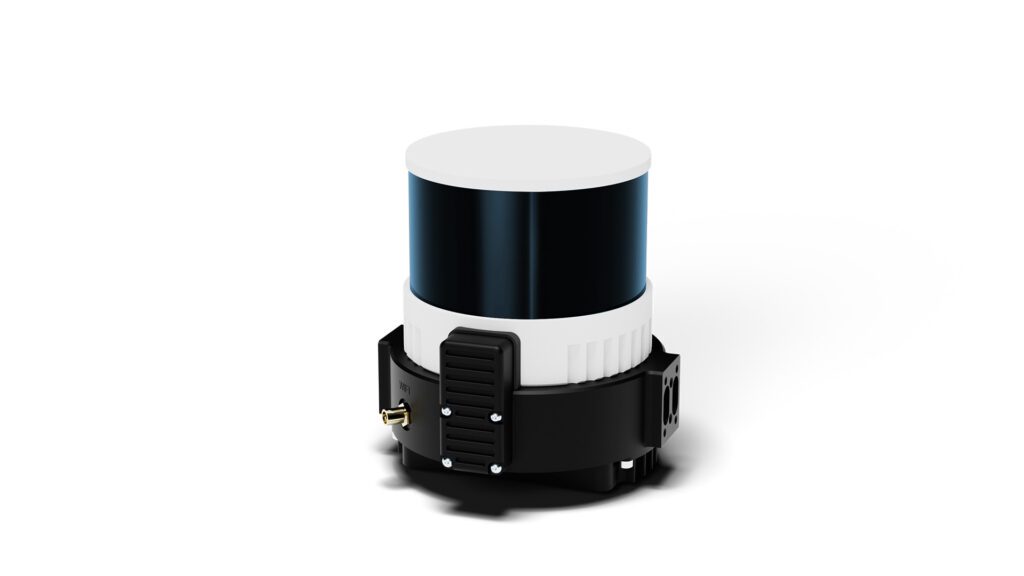
Wingtra’s LIDAR system is based on a lightweight, high-performance sensor, combined with a high-precision inertial measurement unit (IMU). This hardware combo enables the capture of hundreds of thousands of points per second with a high point density on the ground, even at high flight altitudes.
Key features :
- Dot density: up to 300 pts/m² depending on the sensor used
- Absolute vertical accuracy: 2-3 cm
- WingtraOne flight autonomy: up to 59 minutes
- Area covered: up to 300 ha in a single flight
- Compatible with various LIDAR sensors to meet customer requirements
Advantages of Wingtra LIDAR over photogrammetry
Precision in complex terrain
The WingtraOne drone’s LIDAR is distinguished by its ability to generate accurate data, even in the most challenging environments. Unlike photogrammetry, which relies on visual image analysis, LIDAR uses laser pulses to measure distances directly, making it far less sensitive to variables such as shadows, lighting conditions or surface textures. This independence from ambient lighting makes it ideal for surveys in mountainous, forested or densely populated urban areas, where visual contrasts are low and conventional methods are limited.
Terrain modeling under vegetation
One of the Wingtra LIDAR’s major assets is its ability to penetrate plant cover. Thanks to the high frequency of its laser pulses, it can capture multiple return points – including those reaching the ground beneath leaves, branches or tall grass. This makes it possible to generate accurate digital terrain models (DTMs), where photogrammetry could only produce a surface model masked by vegetation. This capability is essential for sectors such as forest management, infrastructure planning in natural environments, precision agriculture and archaeological excavations, where it is crucial to detect the natural relief of the ground.
Low-light or night-time operation
Another decisive advantage of LIDAR is its total independence from ambient light. Unlike cameras used in photogrammetry, which require good lighting to capture usable images, LIDAR can operate effectively at night or in low-visibility conditions (fog, cloud cover, sunrise or sunset). This feature considerably extends the range of operating hours, enabling missions to be carried out at strategic times – notably to minimize disturbance, avoid areas of high human activity or benefit from more stable atmospheric conditions.
Data volume and processing speed
LIDAR sensors generate structured point clouds that can be used directly to create digital models. Unlike photogrammetry, which requires time-consuming photogrammetric processing (image alignment, registration, 3D reconstruction), LIDAR data is ready for use in GIS or CAD software within minutes of flight. This efficiency translates into considerable time savings in projects where reactivity is crucial, such as critical infrastructure inspections, construction site topography or natural risk management. What’s more, the density of points collected is more uniform and independent of ground texture, guaranteeing regular coverage even on monotonous or low-contrast surfaces.
Practical applications for Wingtra LIDAR
Thanks to the combination of LIDAR technology and the WingtraOne drone’s VTOL (Vertical Take-Off and Landing) platform, many sectors can now access high-precision topographic data, in the shortest possible time, with optimum operational efficiency. Here are the main fields of application where this technology stands out.
Forestry: canopy mapping and ecological assessment
The WingtraOne’s on-board LIDAR revolutionizes forest mapping by capturing ground topography even under dense canopy. Unlike photogrammetric surveys, which are often limited by foliage, LIDAR detects the multiple echoes reflected by vegetation, right down to the ground. This makes it possible to :
- Precise estimation of above-ground biomass,
- Modeling tree heights and plant strata,
- Planning targeted silvicultural interventions,
- Preservation of ecological corridors and sensitive habitats.
Case in point: During a project to map 300 hectares of boreal forest, a WingtraOne equipped with LIDAR enabled a fine segmentation of stands, an estimate of standing timber volume and the identification of areas of high ecological value. These data were used to draw up a sustainable harvesting plan that respects local biodiversity.
Civil engineering and infrastructure: precision topographic surveys
In the civil engineering sector, the Wingtra LIDAR is an invaluable ally right from the early stages of a project. It enables detailed topographic surveys to be carried out prior to construction, ground deformation to be monitored, and infrastructure work to be closely monitored.
Its concrete benefits include :
- Precise 3D modeling of the natural terrain,
- Analysis of slopes, embankments and risk areas,
- Reduce the time and cost of manual surveying,
- Improved safety through early detection of instabilities.
Case in point: In a railroad development project, LIDAR data was used to identify landslide-prone areas, optimize the route and adjust earthworks, thus reducing construction costs and times.
Mines and quarries: calculating volumes and monitoring operations
The Wingtra LIDAR is an essential tool for modeling mining and quarrying sites. It offers superior accuracy in the evaluation :
- Volumes extracted or stored,
- Slopes and working faces,
- Access areas and subsidence risks,
- The evolution of the site over time, from a BIM or GIS perspective.
Case in point: the Jellinbah mining group in Australia used WingtraOne equipped with LIDAR to carry out high-precision volumetric surveys, particularly in partially forested areas where photogrammetry alone proved insufficient. The results were used to adjust operating cycles in real time.
Power network management: monitoring and risk prevention
LIDAR is particularly well suited to power line monitoring, especially for :
- Detect plant intrusions threatening high-voltage lines,
- Accurate modeling of easement corridors,
- Identify infrastructures to be maintained,
- Plan interventions proactively, before risks become critical.
Thanks to its stability and autonomy, the WingtraOne drone can cover long distances in a short space of time, with results that can be put to use quickly.
Case in point: An electrical distribution company used Wingtra LIDAR to inspect over 50 km of lines in a semi-wooded environment. Data processing enabled the company to identify potential points of contact between vegetation and cables, and to prioritize maintenance cuts before the storm season.
Urban planning and 3D modeling: digital twins and regional planning
In urban environments, LIDAR technology is indispensable for producing detailed 3D models of complex environments. WingtraOne, capable of stable flight even between vertical structures, can map :
- Buildings, roads, sidewalks, transportation infrastructure,
- Built volumes for sunlight and visibility studies,
- Surface networks (roads, street furniture),
- Heritage and urban safety features.
Case in point: As part of an eco-district planning project, the municipality used a WingtraOne with LIDAR sensor to generate an accurate digital twin. This model served as the basis for citizen consultations, architectural integration simulations and stormwater management planning.
Photogrammetry vs. LIDAR: Comparison table
| Criteria | Photogrammetry | LIDAR Wingtra |
|---|---|---|
| Data type | Georeferenced images | Point cloud (laser) |
| Horizontal accuracy | Up to 1 cm | 1 to 2 cm |
| Vertical accuracy | 2 to 4 cm | 1 to 3 cm |
| Plant performance | Low (visual obstruction) | Excellent (cuts through vegetation) |
| Lighting conditions | Requires good lighting conditions | Works in the dark |
| Point density | Medium to high (depending on resolution) | Very high (up to 300 pts/m²) |
| Processing time | Long (3D reconstruction) | Shorter (direct point cloud) |
| Sensor costs | Less | Higher, but increasingly accessible |
| Main applications | 2D/3D visual mapping, inspection | Topography, forest, infrastructure, volume |
Why choose WingtraOne for your LIDAR projects?
The market is full of LIDAR drones, but Wingtra stands out for :
- Proven reliability: used by government agencies and major industrial groups worldwide.
- Operational efficiency: the VTOL format enables flights in confined or rugged areas.
- Precise mapping: data are compatible with all professional software (Pix4D, TerraSolid, CloudCompare, etc.).
- Customer support: Wingtra offers top-quality technical support and tutorials to help you get up to speed quickly.
- Modularity: you can switch from a LIDAR sensor to a high-resolution RGB camera in just a few minutes.
Conclusion
The LIDAR onboard the WingtraOne GEN II drone represents a major advance in aerial mapping. Thanks to its precision, its ability to capture the terrain beneath vegetation, and its processing speed, it meets the needs of the most demanding professionals in sectors as varied as forestry, public works, network management and mining.
Although photogrammetry remains a powerful and cost-effective solution in certain contexts, LIDAR becomes indispensable as soon as conditions become complex: rugged terrain, dense vegetation, or demands for vertical precision.
In short, choosing a Wingtra system equipped with LIDAR means choosing performance, flexibility and the future.