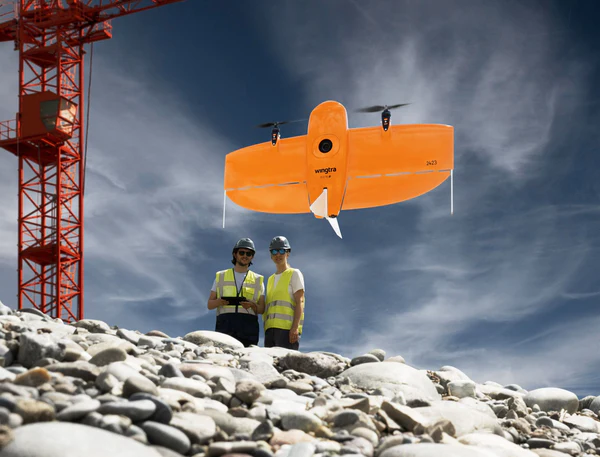
The WingtraOne Gen II has established itself as a benchmark in aerial mapping. This new-generation VTOL flying-wing drone combines performance, autonomy and centimeter accuracy. Designed to meet the needs of the most demanding professionals, it transforms the way geospatial data is collected, whether for topography, precision agriculture, environmental monitoring or large-scale project management.

What is a fixed-wing drone?
Fixed-wing drones are designed with permanent wings, similar to those of a traditional aircraft, making them particularly efficient for covering long distances. This aerodynamic design significantly reduces energy consumption, resulting in a much longer flight range than their rotary-wing counterparts. As a result, these UAVs are particularly well suited to mapping or surveillance missions requiring extensive, continuous coverage of vast areas.
Because of their great autonomy and ability to cover long distances, fixed-wing drones are highly recommended for applications such as geographical surveys, precision farming and environmental monitoring. They are relatively easy to fly, thanks to their aircraft-like flight characteristics. However, it’s important to note that they lack the ability to hover, which limits their use in scenarios requiring immobilization in the air, such as certain high-tech inspections or specific aerial shots.
Thanks to their efficiency and extended range, fixed-wing drones are therefore an optimal solution for professionals who need to collect data over large territories, offering a fast and cost-effective method of obtaining detailed information on areas that are inaccessible or too large to be effectively covered by multi-rotor drones.
How does a fixed wing fly?
VTOL, an acronym for “Vertical Take-Off and Landing”, refers to aircraft capable of vertical take-off and landing. This innovative technology gives VTOL UAVs exceptional flexibility of deployment and maneuverability, making them particularly suitable for operations in urban environments or on rugged terrain where traditional take-off runways are impractical.
One of the main advances in VTOL UAVs is their ability to fully automate the take-off, data collection andlanding process. This autonomy significantly simplifies operations in the field, reducing the need for qualified personnel to handle the aircraft and enabling human resources to concentrate on analyzing the data collected.
The fixed-wing drone vs the quadcopter drone
In the world of professional drones, two models in particular stand out for their configurations and applications: the DJI Matrice 400 a rugged industrial quadricopter, and the WingtraOne GEN II an innovative fixed-wing drone. Each offers specific advantages tailored to different mapping andsurveying needs. Here’s a comparison table highlighting some key specifications.
| Characteristics | DJI Matrice 400 | WingtraOne GEN II |
|---|---|---|
| Type of drone | Quadricopter | Fixed wing |
| Precision | Positioning accuracy to the centimeter (RTK/PPK) | Positioning accuracy to the centimeter (RTK/PPK) |
| Flight coverage | up to 2 km² | up to 8 km² |
| Flying speed | 23 m/s | 16 m/s |
| Cameras and sensors | Wide compatibility: thermal, RGB, LiDAR, etc. | RGB, multispectral and LiDAR sensors |
| Take-off and landing | Vertical (VTOL) | Vertical (VTOL) |
Comparative analysis :
- Accuracy: Both offer centimetric precision thanks to RTK/PPK technology, indispensable for high-precision missions.
- Autonomy and coverage: The WingtraOne GEN II outperforms the DJI Matrice 400 in terms of area covered per flight. It is therefore better suited to large-scale projects requiring long autonomy and extensive coverage.
- Sensor flexibility: The DJI Matrice 400 stands out for its modularity and compatibility with a wide range of sensors, including the Zenmuse H30T LiDAR systems and advanced multispectral sensors, making it ideal for a wide variety of missions (inspection, security, thermography, etc.). The WingtraOne, meanwhile, is optimized for topographic, agricultural or environmental surveys.
- Take-off and landing: Thanks to VTOL technology, both drones can take off and land vertically, enabling operations in restricted or difficult-to-access terrain, without the need for a runway.
The choice between the DJI Matrice 400 and the WingtraOne GEN II depends on specific project requirements. The DJI is ideal for professionals looking for a versatile platform with interchangeable sensor options for complex, diversified missions. The WingtraOne, on the other hand, is the ideal tool for large-scale mapping missions, where coverage, accuracy and autonomy are priorities.
WingtraOne GEN II paraglider presentation
The WingtraOne GEN II is a new-generation fixed-wing drone, designed to offer centimetric accuracy and extensive coverage for aerial mapping missions. Thanks to its VTOL (vertical take-off and landing) technology, it combines the maneuverability of a multirotor with the autonomy and range of a fixed-wing drone.
Equipped with professional interchangeable sensors, the WingtraOne GEN II captures ultra-precise images, ideal for topography, construction, mining, precision agriculture and land management.
Its main assets:
- RTK/PPK accuracy down to 1 cm
- Flight time up to 59 minutes
- Up to 8x more coverage than a multi-rotor drone
- Compatibility with several high-resolution cameras (Sony RX1R II, Oblique, Micasense RedEdge, etc.)
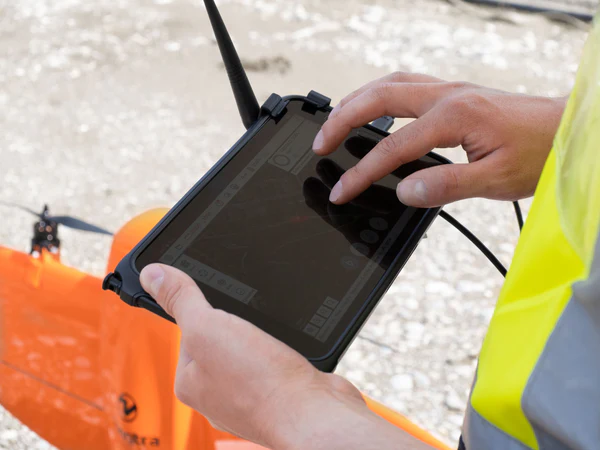
- Simple, intuitive interface with automated mission planning
Reliable, robust and ready to use, the WingtraOne GEN II is an essential tool for demanding professionals in search of productivity and data quality.
Cameras for the WingtraOne GEN II paraglider

WingtraOne GEN II is equipped to support a variety of sensors and cameras, from high-resolution photogrammetry to multispectral and LiDAR sensors. This adaptability allows users to tailor their equipment to the specific needs of each project, whether monitoring the evolution of a natural environment, tracking the progress of a construction site or conducting scientific research. Here’s a detailed overview of these options:
- WINGTRA | Sensor A6100 – 24 MP: This sensor offers a high resolution of 24 megapixels, ideal for capturing the detailed images needed for precise mapping and visual inspection. Thanks to its high definition, it’s perfect for applications requiring great clarity in aerial imagery.
- WINGTRA | Sony RGB61 Payload Kit (GEN II): The RGB61 Payload Kit for the WingtraOne GEN II includes a 61-megapixel Sony sensor. This sensor is designed to provide very high quality RGB images, facilitating detailed analysis for mapping and environmental monitoring projects.
- MAP61 Wingtra sensor: This specific sensor is optimized for aerial mapping missions, providing precise images for the creation of orthophotographic maps and digital surface models.
- Wingtra LiDAR: The LiDAR module for Wingtra enables high-resolution 3D topographic data collection, ideal for complex environments where topographic accuracy is required, such as forestry surveys or corridor studies.
- MicaSense Altum Multispectrale: This multispectral camera combines thermography and five spectral bands. It is mainly used in precision agriculture for crop health analysis, water management and environmental stress monitoring.
- MicaSense RedEdge-MX Thermal: The RedEdge-MX Thermal is an advanced solution that integrates thermal and multispectral sensors. This camera is particularly useful for monitoring and measuring thermal and multispectral variations in applications such as agriculture, ecological research and natural resource management.
The drone is supported by an intuitive user interface and robust software that facilitate mission planning, piloting and data processing. Users can easily configure flights, monitor operations in real time and analyze collected data with ease, further optimizing workflows and enhancing data-driven decision-making.
Frequently asked questions – FAQ
How much does a WingtraOne GEN II fixed wing cost?
WingtraOne Gen II prices vary according to the configuration chosen (sensors, software, accessories, services). For a precise quote tailored to your needs, please contact one of our advisors. You can also view full details of this model here.